Currently browsing tag

programming

An accurate method for Voxelizing Polygon Meshes

Transforming a polygon mesh into a 3D grid / voxel data set is still the quickest way to play with some interesting data in any voxel-based application. You can do this interactively on the GPU, using Eisemann/Décoret’s method, described in Single-pass GPU solid voxelization for real-time applications (2008). When it comes to …

Voxelizing Wireframes

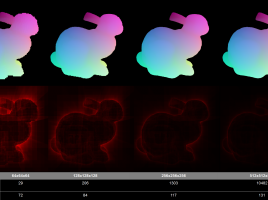
In order to correctly voxelize larger meshes with configurable parameters (shell thickness, seperability parameters, …) I’m now implementing the method described in An Accurate Method for Voxelizing Polygon Meshes, by Jian Huang, Roni Yagel, Vassily Filippov and Yair Kurzion. In the paper, they provide a mathematical basis for voxelizing polygonal meshes, and …

Compiling the WDAS BRDF Explorer

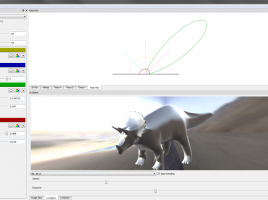
After quite a struggle, I managed to compile the Walt Disney Animation Studios BRDF Explorer (released during SIGGRAPH) myself. Only to find out that a binary has been available for 2 days. I’ll post some quick info on it anyway, for those interested in compiling (future versions) themselves. Thanks go …

Voxel Raycaster: Progress report

After a few weeks of optimizing and getting a lot of good C++ advice from Ares Lagae, I consider my CPU-based voxel raycaster as done. I now have a good framework to test some more interesting stuff on. It offers real-time performance, even for large voxel grids, and I’ve structured the …

Inside id Tech 4

In november last year, id Software released the id Tech 4 source code – the inner workings of Doom 3, that is, on Github, and people have been happily hacking away at it ever since. I found this website by Fabien Sanglard, on which he goes into great detail on …

Octree Data Structures

After some days of tweaking my SVO renderer’s performance, it became clear that I needed a more cache-coherent and space-efficient way of storing/accessing the octree data. I decided to start a seperate C++ project that efficiently converts a .binvox Voxel Grid into a Sparse Voxel Octree. Some discussions with my …

Octrees are your friends

After some painstaking debugging (I guess every programmer can start a post like this), I got my Sparse Voxel Octree-based raycaster working. It’s still all CPU-based, to keep things simple for now. As you can see from the following false color images, the efficient skipping of empty space results in …

Ray / Octree traversal: Parametric algorithm implementation

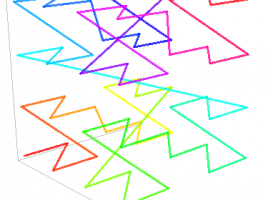
This is my implementation of a Ray/Octree traversal algorithm using an adapted version of the Revelles 2000 paper An efficient parametric algorithm for octree traversal. I’ve made it compliant with IEEE double precision standard. This implementation is minimal and very bare-bones, but should be a good starting point if you want …